Tuesday, 8 March 2011

Illy Caffe in Alicante: Cafeteria Il Duomo

An essential part of my holiday experience is to find a nice little place in every town and city I visited, which serves good Italian-style coffee made with illy coffee beans. And Alicante is no exception. As soon as I arrived at the city centre, I immediately set out for the search for a nice place to have my daily round of afternoon coffee.


Cafeteria Il Duomo is just a short distance away across the street opposite Alicante's famous central fresh-produce market, on the city's busy throughfare Alfonso el Sabio. The cafe is run by a friendly owner from Paraguy who attended coffee-brewing training and barista course at Illy's headquarters in Trieste, Italy.


Sunday, 6 March 2011

Valencia Revisited, Part Three: The Beach and Port America's Cup Marina

One thing which has puzzled me for quite sometime is, despite the presence of a beautiful beach in Valencia, it seems no one from outside of this city has taken notice of its existence. Unlike nearby Alicante and the Costa Blanca, where beaches are swamped with people in the summer and on weekends, the well-equipped and beautiful sandy white beach of Valencia has been somewhat 'devoid' of visitors. Which, of course, is a good news for people like me who prefer quiet, secluded beach spots to sites of popular tourist onslaughts witnessed elsewhere along the Costa Blanca.


The beach front promenade, which goes on for miles along the coastline, is planted with palms and evergreen scrubs. And rows of hotels with seaview rooms, cafes and elegant al fresco dining restaurants line the side of the boulevard facing the landscaped garden.


Saturday, 5 March 2011

Valencia Revisited, Part One: Ciutat de les Arts i les Ciències by Sanitago Calatrava and Felix Candela

In the last ten years, the municipality of Valencia has chosen to pump in huge amounts of money to re-develope certain less privileged parts of the city. The huge cultural and exhibition complex, Ciudad de las Artes y las Ciencias (City of Arts and Sciences), was a multi-million urban renewal project envisaged to provide a new lease of life to a previously neglected part of this fast-growing metropole.


The whole complex is built on the former river bed of the River Turia, which used to run through the centre of Valencia. Designed by renown Spanish architects Santiago Calatrava and Felix Candela, the entire park stretched for several kilometers and is now a popular weekend destination for locals and visitors alike. 


Fans of modernist architectural style would not be failed to be impressed by the bold, futuristic lines of the buildings of the City of Arts and Sciences. Being a native of Valencia, Santiago Calatrava rose to international prominence in the 1990s, following the success of his widely acclaimed design of the giant Montjuïc Communications Tower - also known as Torre Telefonica, a satellite and communications tower built for Spain's telecommunications company Telefonica - at the heart of Barcelona's Olympic Games ground. Nowadays the works of Calatrava can be found all over the world, from Europe to North America and beyond.


Friday, 4 March 2011

Valencia Revisited, Part Two: La Lonja de la Seda (Llotja de la Seda)

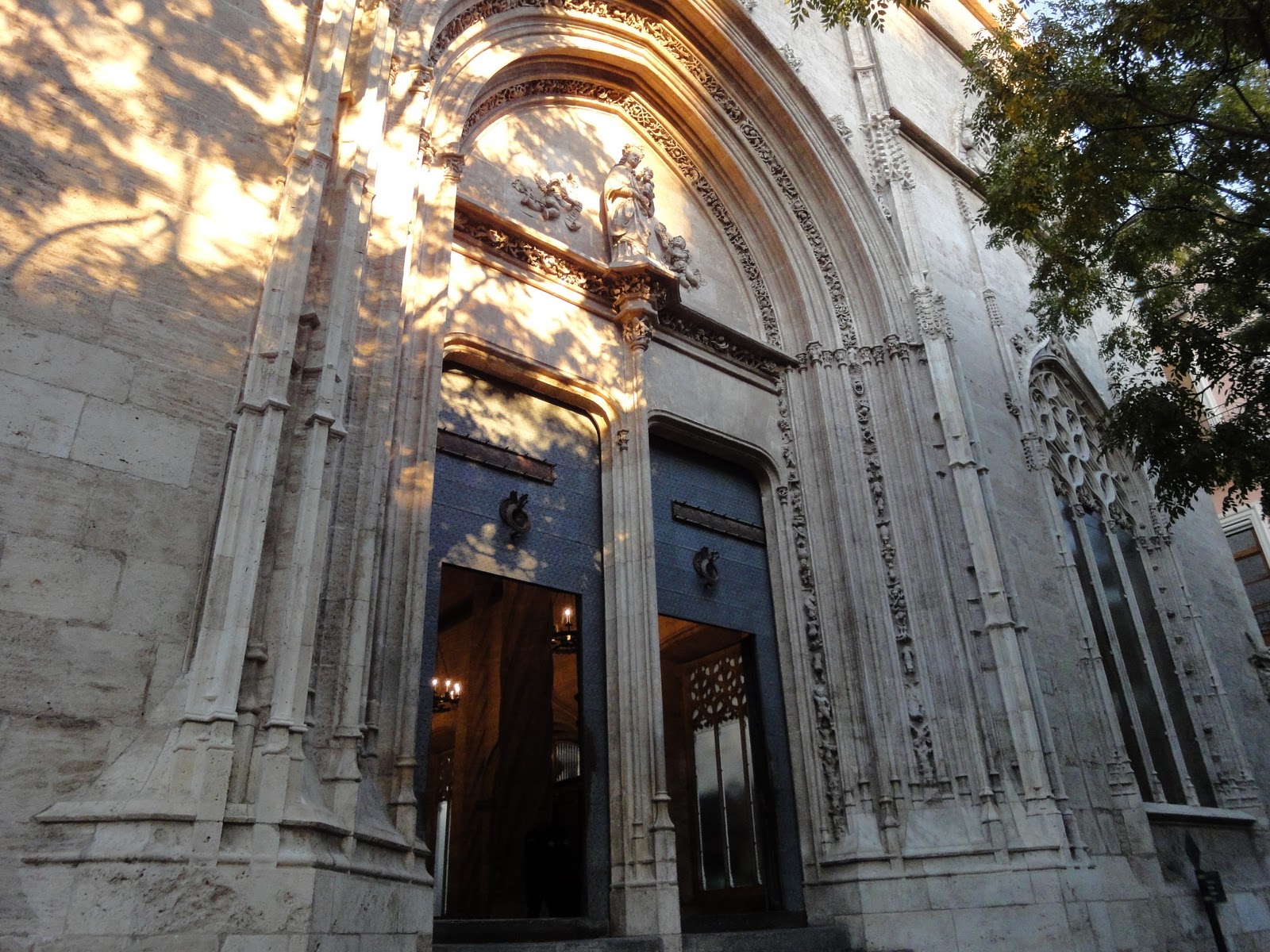
Known as La Llotja de la Seda in Valencian (La Lonja de la Seda in Spanish), this beautiful Gothic building in the centre of Valencia, built between 1482 and 1548, is a prime example of a medieval Gothic-style civil building in the Mediterranean region.


Nowadays, this remarkable building with trademark Gothic columns, gargoyles and a lush inner courtyard planted with orange tree, is one of Valencia's foremost tourist attractions. Originally a silk exchange for merchants based in Valencia, Lonja de la Seda was inscribed by UNESCO since 1996 as a World Heritage site due to is uniqueness as a purely civilan building built in the  Gothic style, an architectural style otherwise associated with ecclesiastical buildings in the Middle Ages and rarely used among civil buildings.


La Lonja is situated right across the street from Valencia's main mercado or central market. A plaque which commenorates the building's inscription as a UNESCO World Heritage site is erected next to the main entrance to La Lonja.

Monday, 28 February 2011

Journey along the Eastern Coast of Spain Part I: Tarragona

I was looking for a place to break my journey between Barcelona and Valencia, and Tarragona seems to be the ideal place for me to spend a night. About one-and-a-half hour away by bus from Barcelona's El Prat airport, direct bus service links the gateway to Barcelona with several renown coastal resort towns such as Tarragona, Reus, Salou, and Cambrils. 


The bus from Barcelona El Prat airport leaves from the bus station in front of Terminal One and arrives at Tarragona's main bus station, situated at the centre of  Tarragona. From the bus station, it is a 20-minutes walk uphills along the main throughfare of the city - Rambla Nova - to the Old Town of Tarragona, where most of the city's tourist attractions are.


Saturday, 26 February 2011

Konyaalti Beach, Antalya: Russians' Favourite Beach in Turkey

Some said Konyaalti is probably the most famous beach in Turkey. Well, although all-inclusive beach holidays is not exactly my cup of tea, I too find Konyaalti quite a convenient place for a beach weekend holiday with your family and kids, especially if you are a fan of 'sun, sea, beer and fun' style of all-inclusive package holiday, and you are very much into highly charged beach life style best known on the Spanish islands of Ibiza and Mallorca.


Popular beaches in the Mediterranean - some examples of which include the southern coast of Mallorca, Spain's Costa del Sol, Ibiza, Portugal's Algarve, and Turkey's Antalya - all have something in common, namely lots of beach bars and seafront discos with  dance floors, ocean-view stage and mega loud-speakers blurting out cheesy European and American pop music throughout the day. To be honest, I prefer beaches which are quiet, selcuded and less crowded, but there are people who do enjoy doing their daily rounds of swimming in the company of modern cafe bars, loud music and countless other people, so each to his own.  
 

Thursday, 24 February 2011

Journey along the Eastern Coast of Spain Part IV: Alicante

The very name of Alicante has long been synomonous to perfect sun, flawless beach, mildeclimes, and warm blue sea. This place has been on my target list of 'must-see' places in Spain for years, but strangely enough, in spite of the easy availability of budget flights from all over Europe to Alicante, and despite the fact that I had already visited some really out-of-way, even obscure places in Spain, it was not until recently that I finally had the opportunity to visit Alicante.


So Alicante and its famed beach, here I come!!

Wednesday, 23 February 2011

Journey along the Eastern Coast of Spain Part III: Calp/Calpe

After spending several leisurely days in Valenica, I decided to head along the coast towards the direction of Alicante. My initial plan was to go straight to Alicante by train, but as I opened the map and study the route, I thought the journey would be more interesting if I take a slight detour and take a look at some of the world-renown coastal resort towns on the Costa Blanca before arriving at Alicante.


The unusal sounding name Calp in Valencian (Calpe in Spanish) caught my attention. It sounds interesting, like some kind of seashells. And it seems the place is not as touristic or overcrowded as nearby Benidorm. After a brief research on the internet, I went to Valencia's bus station and bought a ticket to Calpe.


Journey along the Eastern Coast of Spain Part V: Murcia

With all its honey-coloured stone houses and grand cathedrals, Murcia is actually a very picturesque and sweet city. About two hours by train from Alicante, this little inland city offers some interesting sights, most notably its medieval Cathedral and its arrays of Spanish Baroque houses. Known for its mild climates in winter, Murcia is a good place to spend a few days in the sun if you happen to find yourself touring around the south-eastern coast of Spain.


The beautiful town hall of Murcia lies right on the bank of the Segura River, close to the Puente de los Peligros, a 18th century bridge and the oldest bridge in Murcia. Just like in neighbouring Cathargena, metal sculptures of fish can be seen 'swimming around' in the river.


Monday, 21 February 2011

Journey along the Eastern Coast of Spain Part VI: Cartagena

Cartagena - this name always reminds me of Carthage, the once significant maritime power whose sphere of influence stretched all the way from northern African coast (modern day Tunisia, parts of the coast of Libya, Morroco, and Algeria) to southern Spain, the Belares Islands, as well as Sardinia, Corsica and parts of the island of Sicily.


Founded by a Carthaginian general in 228 BC, the city of Carthagena has been long an important naval base throughout its long history due to its strategic location and the natural deep-water harbour. The town is now the main military seaport of the Spanish Navy, and is home to a big naval shipyard and a regular port-of-call of several renown cruise lines.


Sunday, 23 January 2011

Cafes of Vienna: Cafe Bellaria - Fin de siècle Elegance

If you ask me which is my most-preferred cafe in Vienna, I would definitely name Cafe Bellaria as my all-time favourite. It has such an irresistable charm and such enduring elegance, I could spend the whole week in the cafe without feeling bored. 


Just a short walk from Vienna Natural History Museum, Cafe Bellaria has everything I look for in a cafe: history, tradition, friendly service, delicious cakes and tasty food at reasonable prices, and a genuinely Viennese atmosphere unmatched elesewhere.


Saturday, 15 January 2011

Cafes of Vienna: Cafe Eiles - Truly Authentic Cafe in Josefstadt

Josefstadt is a very lively and interesting business and residental district close to the city centre of Vienna. Barely five minutes away by tram from Vienna's Ringstrasse, this district is a whole world away from the touristic kitsch of the city centre. It makes a refreshing change to stroll along the narrow streets of Josefstadt, brushing shoulders with locals, admire the window display of independently-run fashion boutiques, jewellery shops, florists, household gift stores etc. 
 

Cafe Eiles is a very well-known local cafe in Josefstadt, just 300m from Vienna's City Hall. The cafe is amongst my favourite Viennese hangouts. It evokes a feeling of nostalgia, with its slightly faded  carpets and floral-pattern seatings, spacious interior, high ceilings which allow natural lights to illuminate the whole salon, round coffee tables with marble surface top, and the obligatory staples of newspapers and old black-and-white photos from the bygone eras.


Cafes of Vienna: Cafe Schwarzenberg - Some Things Are Better in the Past

Cafe Schwarzenberg was once amongst my favourite coffee houses in Vienna, but that was more than fifteen years ago. I used to be very fascinated by the splendor of its decor, the spirit of its grandiose ambience, as well as its palacial elegance, smooth coffee, and heavenly cakes. But how things haved changed since the early 1990s!!


During my latest visit to Vienna, I made it a priority to visit Cafe Schwarzenberg in the hope of reliving that heavenly hazelnut cream with chocolate cake again. But to my utter disappointment, the whole place has become a mega touristic magnet now. Virtually more than half of the people sitting inside speak no German at all, many of them are obviously first-time foreign tourists to Vienna, who choose to come to Cafe Schwarzenberg because their guidebooks told them to do so.

Thursday, 13 January 2011

Cafes of Vienna: Cafe Frauenhuber - where Mozart used to Perform

Most of the well known traditional historical cafes inside Vienna's historical city centre (Innenstadtbezirk) are packed with tourists seven days a week. Although some of them are popular amongst foreign tourists because of hype, but some of them do have something special about them.
Cafe Frauenhuber, founded in 1824, is one of those famous old Viennese cafes that has something truly unique about it. First of all, the service is exceptional - this cafe has one of the most friendly waiters I have ever met in Austria.


Secondly, the cafe is located in a building with a truly special history: it is the place where Mozart and Beethoven used to give live public concert performance during their active years. Very few other cafes in the world could have claimed such honours. Mozart made his last visit to this building in March 1791, shortly before his death six months later.


Tuesday, 11 January 2011

Cafes of Vienna: Cafe Tirolerhof

This is the only cafe in Vienna's city centre which is not full of tourists during peak hours. Located right at the corner of Albertina Museum, this cafe is a place of refuge for those who are looking for a quiet spot to escape from the crowds in the middle of the city centre.


Like most of the traditional cafes, the interior design is simple and classic, perhaps not as glamourous or impressive as Cafe Schwarzenberg or Cafe Central, but nevertheless still radiates that distinctive Viennese flaire.


Sunday, 9 January 2011

Cafes of Vienna: Cafe Raimund

Cafe Raimund is located right across the Volkstheatre on the Museumstrasse, the nearest subway station is U-Bahn Volkstheatre. It is a beautiful old-school Viennese cafe with lots of mirrors, old photos, soft red plush interiors, and a gentle, subtle elegance. It is not as touristic as the cafes on the Ringstrasse, but its convenient location right across the road from the Museum Quarter and the Volkstheatre makes it a favourite hangout for theatre-goers and art lovers who want to have some food and drinks before or after the shows and exhibitions.   

I found this place so much more congenial and authentic than most of the big-name places inside Vienna's Ringstrasse.


The interior of the cafe has that trademark 19th century Viennese cosmopolitan touch, with warm rays of sunlight seeping through the large windows. The tastefully decorated salon, although a bit old-fashioned, has such an airy, cosy feeling, it makes you feel like staying there for the whole afternoon.


Saturday, 8 January 2011

Cafes of Vienna: Cafe Sperl

Someone recommended this cafe, so I decided to give it a try. The history of Cafe Sperl dated back to 1880, at a time when Vienna was the political and cultural centre of a vast multi-ethnic empire and the birthplace of various intellectual and artistic movements. 


The cafe is housed in the 6th district of Vienna, near the popular shopping miles of Mariahilferstrasse. The interior decoration radiates a classical elegance typical of the now bygone Fin de siècle era. A snooker table, full of newspapers, await the customers inside the spacious lounge. There are far more locals inside the cafe, much less tourists. I chose a place next to the large windows and ordered a regional speciality available only in the autumn months - pumpkin soup with pumpkin seeds and pumpkin oil.


Friday, 7 January 2011

Cafes of Vienna: Cafe Hummel in Josefstadt

For those in the know, some of the most popular and best cafes in Vienna are located outside the touristy inner city district. In Josefstadt, a colourful and lively multi-ethic district just a short ride by tram from the Ringstrassen, there are several marvellous family-run cafes with plenty of tradition and history, whose owners have continued to serve authentic Viennese cuisines and good coffees to a demanding public for decades.

Cafes of Vienna: Kleines Cafe

This little place is tucked away at the corner of Franziskanerplatz inside Vienna's central district (Innenstadt). The cafe, true to its name, is indeed a very small one, with barely ten sets of chairs and tables inside, but it is a truly warm and intimate place to have your daily round of coffee and cakes, especially on a beautiful sunny autumn day or in the quiet hours after the evening meal.

Being at a part of Vienna's old town some distance away from the usual beaten tourist tracks, this small cafe is a popular hangout of local students and the general public. As it is not as crowded or well-known as the other big name historical cafes in the city centre, one does not have to queue up for hours before gaining admission to the premises. Once inside, one can spend as much time as one fancies reading, writing, or sampling the coffee, without the need to feel obliged to give up the seat for those waiting at the door. 

Saturday, 1 January 2011

Cafes of Vienna: Cafe Prückel

Founded in 1904, Cafe Prückel is one of my favourite traditional Viennese cafes. Located near the Universität für angewandte Kunst Wien (University of Applied Arts and Design), this cafe has been a favourite hangout for lecturers and students of that institution for ages.


Although Cafe Prückel is considered one of the best known Viennese Kaffeehäusern, the place has retained its sense of authentic charm, in spite of its location on Vienna's prestigeous Ringstrassen. Its airy, sleek modernist interior, designed by famous Viennese architect Oswald Haerdtl in 1954, introduces plenty of natural light into the interiors of the cafe. This classic example of 50s' modernist design has been a trademark of Cafe Prückel for more than half a century.